

Kitchen Cabinet Painting & Refacing Toronto: Costs & Results
Want a kitchen transformation without a full renovation? Learn whether cabinet painting or refacing is right for your Toronto home, what it costs, and how to get lasting results.

Expert Team
Kitchen Renovation Specialist
November 7, 2025
Updated for Toronto Market
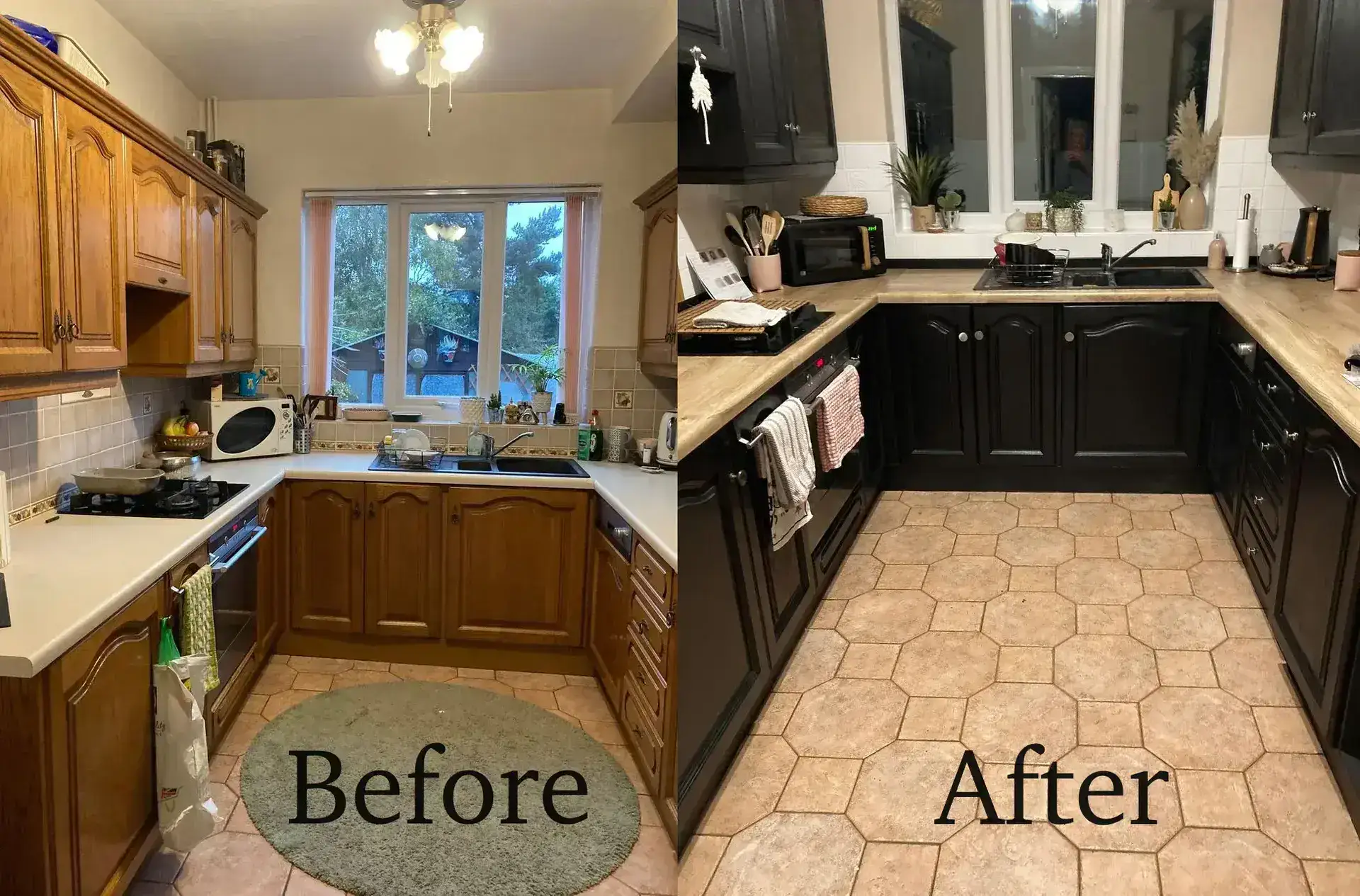
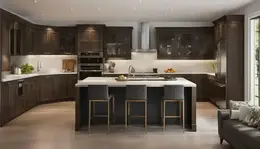
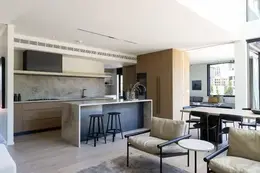
Kitchen cabinet transformation through professional painting - achieves a high-end look at a fraction of replacement cost
Quick Summary: Cabinet painting in Toronto costs $2,500–6,000 and takes 3–5 days. Cabinet refacing costs $5,000–12,000 and takes 5–7 days. Both can transform an outdated kitchen without the $25,000–50,000 cost of full cabinet replacement. Painting has the best ROI; refacing is better when you want new door profiles.
Is Cabinet Painting Worth It in Toronto?
Kitchen cabinet painting in Toronto has exploded in popularity as homeowners look for impactful renovations at reasonable budgets. The math is compelling: a full kitchen cabinet replacement costs $20,000–50,000+, while professional painting achieves a visually stunning transformation for $2,500–6,000 - a saving of 80–90%.
In Toronto's hot real estate market, even rental properties and investment homes benefit dramatically from cabinet painting. Listings with freshly painted white or two-tone cabinets consistently receive more offers and sell at higher prices than those with dated oak or builder-grade brown finishes.
The real question isn't whether cabinet painting is worth it - it almost always is. The real question is whether your specific cabinets are good candidates. Solid wood and plywood-box cabinets with flat or shaker-style doors paint beautifully. Raised-panel hardwood doors with deep grooves can trap paint and require extra attention. Thermofoil-wrapped cabinets that are peeling are typically better candidates for door replacement rather than painting. A professional assessment takes 30 minutes and answers all of these questions before you spend a dollar.
Cabinet Painting vs Refacing vs Replacement: Which Is Right for You?
| Option | Typical Cost | Timeframe | Best For |
|---|---|---|---|
| Cabinet Painting | $2,500 – $6,000 | 3–5 days | Colour update, budget projects, solid wood cabinets |
| Cabinet Refacing | $5,000 – $12,000 | 5–7 days | New door style, sound boxes, mid-range budgets |
| Full Replacement | $20,000 – $50,000+ | 2–4 weeks | Layout change, damaged boxes, full renovation |
The decision between these three options hinges on a few key factors: the structural integrity of your existing cabinet boxes, your desired door style, your timeline, and your budget. Cabinet refacing sits in an interesting middle ground - it gives you the feel of new cabinets (new door profiles, new veneer on the boxes) while preserving your existing layout and avoiding the cost of full replacement. For homeowners who love their kitchen layout but hate their flat, dated doors, refacing is often the sweet spot.
The Professional Cabinet Painting Process
Cabinet refinishing in Toronto done right is a multi-step process that takes more skill than painting walls. Here's what a proper professional job looks like:
Remove All Doors and Hardware
Doors, drawer fronts, and hinges are removed and labelled. Cabinet boxes stay in place. Hardware is cleaned or replaced. Removing doors is non-negotiable for a factory-smooth finish - painters who work with doors in place always leave visible hinge lines and uneven coverage.
Thorough Cleaning and Degreasing
Kitchen cabinets accumulate years of grease and oil - especially on uppers near the stove and on door surfaces near handles. Professional-grade degreaser (TSP substitute or similar) removes all contaminants that would prevent paint adhesion. This step alone is responsible for the majority of DIY cabinet paint failures within the first two years.
Sanding and Scuff Preparation
All surfaces are scuff-sanded with 120–180 grit paper to create mechanical adhesion for the primer. Wood grain is smoothed. Filler is applied to dents, nail holes, and imperfections and allowed to fully cure before sanding flat. This step determines the final smoothness of your painted surface - rushed preparation always shows in the finished product.
Primer Application
Shellac-based primer (like Zinsser BIN) or a high-adhesion bonding primer is applied to all surfaces. On raw wood, shellac primer seals tannins that would bleed through topcoats and cause yellowing. On laminate, bonding primer creates the adhesion that makes paint stick where it otherwise wouldn't. This is the step that separates a 2-year paint job from a 10-year paint job.
Spray Application of Cabinet Paint
Professional HVLP or airless spray equipment provides a factory-smooth finish impossible to achieve with brushes or rollers. 2–3 topcoats of cabinet-grade paint (Benjamin Moore Advance, Sherwin-Williams Emerald Urethane, or 2-part catalyzed lacquer) are applied with light 220-grit sanding between coats to remove any dust nibs. The result is a glass-smooth surface that's both beautiful and highly durable.
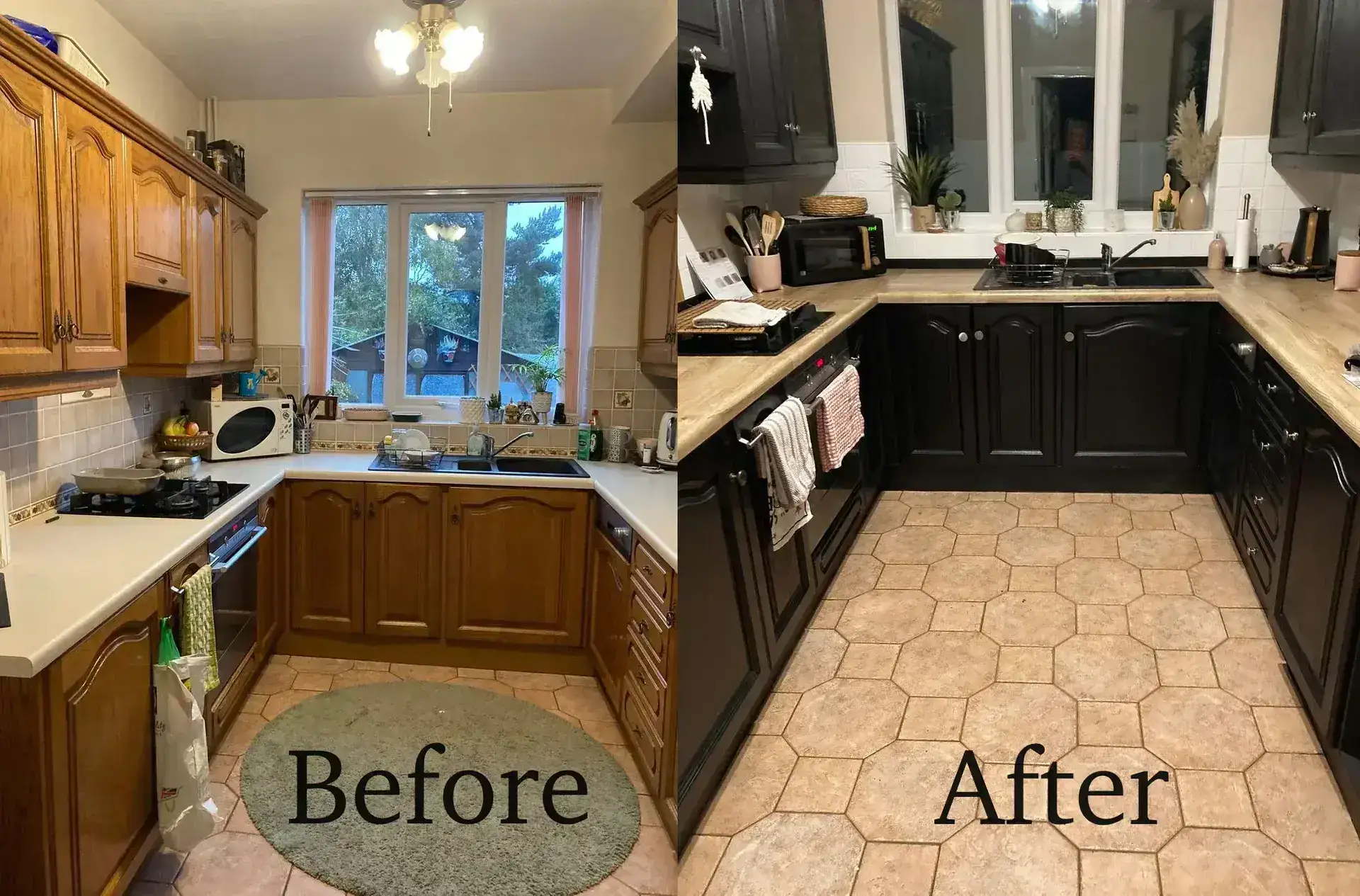
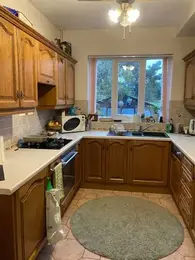
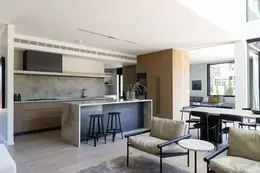
Before and after: dated honey-oak cabinets transformed with professional white cabinet painting - same doors, same layout, completely different kitchen

Kitchen cabinet refacing - new shaker-style doors with custom hardware on original cabinet boxes
Most Popular Cabinet Paint Colours in Toronto (2026)
Trending Colours
- • Accessible Beige / White Dove (Benjamin Moore)
- • Chantilly Lace (BM) - true white, very popular
- • Tricorn Black (Sherwin-Williams) - bold lowers
- • Pale Oak / Revere Pewter - greige tones
- • Navy Blue uppers with white lowers - two-tone
Finishes That Last
- • Satin (most forgiving, easy to clean)
- • Semi-gloss (highest durability, shows imperfections)
- • Cabinet-specific enamels (Benjamin Moore Advance)
- • 2-part catalyzed finishes (maximum hardness)
- • Avoid flat/matte - impossible to clean
For a truly comprehensive kitchen transformation, consider pairing cabinet painting with new countertops, backsplash, and lighting. Our full kitchen renovation service in Toronto can coordinate all these elements for maximum visual impact and value.
Two-Tone Cabinet Design Guide: The 2026 Trend That's Here to Stay
Two-tone cabinet design - painting upper and lower cabinets in different colours - is no longer a trend. In 2026, it's the standard for any kitchen that wants to look current and intentional. Interior designers and real estate stagers consistently recommend two-tone kitchens because they create visual depth, anchor the room, and photograph beautifully for listings.
The principle behind two-tone design is visual weight. Dark colours are "heavy" and belong at the bottom, where they ground the room and mimic the visual weight of countertops and flooring. Light colours are "airy" and belong on the upper cabinets, where they connect with the ceiling and keep the room feeling open. Breaking this rule (dark uppers, light lowers) creates an inverted, top-heavy feeling that most homeowners find unsettling - even if they can't articulate why.
Navy / White
The classic two-tone combination. Navy lower cabinets (try Benjamin Moore Hale Navy or Sherwin-Williams Naval) paired with crisp white uppers (Chantilly Lace or White Dove) creates a timeless, nautical-inspired kitchen that appeals to virtually every buyer demographic. Works especially well with brass or gold hardware and white quartz countertops.
Best for: Traditional homes, detached houses, resale preparation
Forest Green / White
The freshest combination of 2025–2026. Forest or sage green lowers (Benjamin Moore Black Forest Green or Sherwin-Williams Rosemary) with white uppers read as organic, sophisticated, and distinctly on-trend. This combination photographs exceptionally well and has strong appeal among millennial and Gen-Z buyers.
Best for: Condos, semi-detached homes, younger buyer markets
Charcoal / Cream
Sophisticated and gender-neutral. Charcoal lowers (Sherwin-Williams Peppercorn or Benjamin Moore Kendall Charcoal) with warm cream uppers (Benjamin Moore White Chocolate or Linen White) creates a warm, high-end kitchen that pairs perfectly with butcher block or warm-toned quartz. Avoids the "sterile" feeling of pure black-and-white combinations.
Best for: Warm-toned homes, open-concept kitchens, higher-end properties
Black / White
The boldest two-tone choice and still a strong performer. Matte or satin black lowers (Sherwin-Williams Tricorn Black or Benjamin Moore Onyx) with bright white uppers creates maximum contrast and a modern, restaurant-inspired kitchen. Requires confidence in the design, but delivers a dramatic result that most buyers remember long after their showing.
Best for: Modern homes, design-forward buyers, high-contrast spaces
Two-Tone Design Rules to Follow
- Always darker on the lowers: Visual weight anchors the room. Exceptions rarely work without professional design guidance.
- Match your island to your lowers: A kitchen island should mirror the lower cabinet colour, not the upper. This creates visual continuity and makes the island feel intentional.
- Hardware should be consistent: Choose one metal finish and use it on both upper and lower cabinets. Mixing gold pulls with chrome knobs creates visual chaos.
- Sample on actual doors first: Paint a removable door in both colours and live with it for 48 hours under different lighting conditions before committing.
- Consider the transition point: The line between your two colours typically runs along the underside of the upper cabinets or at a defined horizontal rail. Ensure this transition is clean and properly masked.
Kitchen That Sits - or Kitchen That Sells?
Toronto buyers walk away from dated kitchens. Most mentally deduct $15,000–30,000 from their offer the moment they see honey-oak cabinets from 1998. Your kitchen doesn't need a full renovation - it needs the right update.
Call us for a free in-home cabinet assessment. We'll tell you honestly whether painting, refacing, or replacement is the right move for your home and your goals.
The Hidden Cost of NOT Updating Your Cabinets
Most Toronto homeowners think of cabinet painting as an optional aesthetic upgrade. What they don't realize is that not updating dated cabinets carries a very real financial cost - especially for anyone planning to list their home within the next 2–3 years.
What Dated Kitchens Cost You at Resale
- $15,000–30,000 mental deduction: Buyers and their agents automatically subtract estimated renovation costs from their offer price when they see dated oak or builder-grade brown cabinets. Even if they don't consciously calculate it, the number is in their head during negotiations.
- 60+ days longer on market: Toronto real estate data consistently shows that homes with dated kitchens sit longer than comparable homes with updated finishes. Every extra day on market increases carrying costs and signals to buyers that something is wrong.
- Conditional offers and reduced leverage: Buyers who see a dated kitchen use it as negotiating leverage. Inspection conditions, furniture inclusions, and price reductions are all more common in homes where the kitchen needs work.
- Spring listing season urgency: The Toronto spring real estate market (March–June) is when the most buyers are active and competition among sellers is highest. Homes that enter this window with fresh, updated kitchens consistently outperform their neighbours. If you're planning a spring listing, cabinet painting needs to be booked by February at the latest.
The ROI math is difficult to argue with: a $3,500–5,000 cabinet painting project can recover $15,000–30,000 in lost offer value, reduce your time on market by weeks, and eliminate the negotiating leverage buyers use to chip your price down. Few home improvement investments come anywhere close to that return.
Real estate agents in Toronto's most competitive markets - Leslieville, Roncesvalles, the Annex, North York, and Mississauga - all say the same thing: updated kitchens close faster and for more money, period. Cabinet painting is the single highest-ROI pre-listing investment available to Toronto homeowners.
Cabinet Paint Failure: What Went Wrong (3 Real-World Scenarios)
Not all cabinet painting projects succeed. In our years working across Toronto, we've been called in to fix failed DIY jobs and poorly executed contractor work. Here are the three most common failure scenarios, what they look like, and what it costs to redo them.
Scenario 1: Wrong Primer on Laminate Cabinets
What happened: A Scarborough homeowner hired a general painter (not a cabinet specialist) to paint their IKEA laminate cabinets. The painter used standard drywall primer - the right product for walls, entirely wrong for laminate. Within six months, the paint began peeling off in large sheets, especially around door edges and high-touch areas near handles.
What it looks like: Paint lifts cleanly off the laminate surface, almost like removing a sticker. The laminate beneath is undamaged. The failure is always at the primer-to-substrate bond, not within the paint layers themselves.
Cost to redo: $2,800–4,200 to strip all paint, properly abrade and prime with bonding primer, and repaint. The lesson: laminate requires a specialized adhesion primer (Zinsser BIN, Stix, or similar). Always confirm your painter's laminate experience before hiring.
Scenario 2: Painted Over Grease Contamination
What happened: A North York homeowner attempted a DIY cabinet paint job on a kitchen that had seen 15 years of cooking without a range hood. They wiped the cabinets with a damp cloth, but did not use a proper degreaser. The paint appeared fine initially. Within three months, greasy patches began showing through the topcoat, and the paint in areas near the stove began bubbling and separating from the surface beneath.
What it looks like: Yellowish or brownish stains bleeding through the topcoat (even through white paint). Bubbling or blistering in high-heat zones. A slightly tacky feeling to the painted surface in contaminated areas that never fully cures.
Cost to redo: $1,800–3,000 depending on how many doors are affected. Requires chemical stripping in some areas, full degreasing with TSP substitute, shellac-based stain-blocking primer, and new topcoats. Lesson: proper degreasing is a 1–2 hour process, not a 10-minute wipe-down. There are no shortcuts.
Scenario 3: Brush Marks and Roller Texture on Cabinet Doors
What happened: A Mississauga homeowner hired a painter who claimed cabinet experience but applied the topcoats with a brush and foam roller rather than spray equipment. The finished product showed visible brush strokes on flat door panels and orange-peel texture from the roller on raised sections. The homeowner had spent $2,200 and had cabinets that looked worse than painted walls.
What it looks like: Visible parallel striations in the finish from brush bristles. Bumpy, pebbled texture from rollers (even high-density foam rollers leave texture on flat surfaces). The effect is especially visible when light rakes across the surface at a low angle - which is exactly how kitchens are lit most of the day.
Cost to redo: $2,500–4,500 to sand all surfaces back to flat, re-prime, and re-spray with proper equipment. The lesson: cabinet painting without spray equipment is not professional cabinet painting. Always ask specifically whether spray application is used - and ask to see photos of previous work.
Professional spray-applied cabinet finish on a Toronto project - the factory-smooth result only possible with proper equipment and technique
DIY vs Professional Cabinet Painting: The Real Comparison
Why DIY Cabinet Painting Usually Disappoints:
- Brush and roller marks are nearly impossible to eliminate without spray equipment - and spray equipment requires training, practice, and proper ventilation setup
- Incorrect primer causes paint to chip within 1–2 years, especially on laminate or high-use surfaces near handles
- Missing the degreasing step leads to adhesion failure in high-use areas and stain bleed-through near the stove
- DIY cost ($500–1,500 in materials, plus equipment rental) vs professional ($2,500–6,000) - the gap is smaller than most expect, especially when you factor in your time (typically 40–80 hours for a full kitchen)
- A failed DIY job still requires professional refinishing - costing more in total than hiring a professional from the start
- DIY jobs typically void any warranty on cabinet finishes and can complicate pre-listing disclosures if the work is visible
Our custom cabinetry team also offers full cabinet replacement with premium custom cabinetry for homeowners ready for a complete transformation. We can help you determine the best investment for your specific situation and budget.
New Hardware: The $500 Upgrade That Changes Everything
Freshly painted cabinets with old hardware are like a new suit with scuffed shoes. The hardware - pulls, knobs, and hinges - is what your hand touches every single day. It's what guests notice first when they walk into your kitchen. And it's one of the most overlooked parts of a cabinet transformation.
Replacing all hardware in a standard Toronto kitchen (15–25 doors and drawers) typically costs $300–800 in hardware plus installation - a trivial investment relative to the overall project. The visual impact, however, is disproportionately large. The right hardware can make your painted cabinets look like a $50,000 custom kitchen. The wrong hardware (or kept-in-place original hardware) can make even a perfectly painted cabinet look like it didn't quite get finished.
Finger-Pull / Integrated Handle
A routed groove in the door itself, with no separate hardware. Ultra-minimal, Scandi-inspired look. Best for flat-panel (slab) doors in modern and contemporary kitchens. Requires refacing or new doors - cannot be retrofitted to existing doors.
Cost: Included in door cost if refacing; $0 in hardware spend
Bar Pull
Long horizontal or vertical metal bar pulls are the current dominant hardware style in Toronto kitchens. Available in matte black, brushed nickel, satin brass, and chrome. Bar pulls work on virtually any cabinet style and create a clean, modern look that photographs beautifully. Standard sizes: 96mm, 128mm, and 160mm for doors; 192mm–256mm for drawers.
Cost: $5–25 per pull; $150–500 for a full kitchen
Cup Pull
A curved, bin-style pull primarily used on drawer fronts. Cup pulls add a farmhouse or transitional character that pairs beautifully with shaker-style cabinet doors painted in forest green, navy, or charcoal. Often mixed with knobs on doors and cup pulls on drawers for a layered, high-end look.
Cost: $8–30 per pull; $200–600 for a full kitchen
Hardware Pairing Guide by Cabinet Colour
- White cabinets: Matte black or brushed brass bar pulls - creates maximum contrast and a crisp, designed look
- Navy or forest green: Satin brass or unlacquered brass - the warm gold against cool green or navy is the combination interior designers charge for
- Charcoal or grey: Brushed nickel or polished chrome - keeps the palette cool and cohesive
- Two-tone kitchens: Use one hardware finish throughout both colours - do not mix metals between upper and lower cabinets
- Black cabinets: Matte black (tonal, very modern) or brushed brass (high-contrast, maximalist)
Before & After: Real Toronto Kitchen Transformations
Numbers are useful, but real projects tell the story better. Here are three cabinet transformations we've completed across the GTA, with approximate costs and outcomes.
Two-Bedroom Condo Kitchen - Liberty Village-Style Flat-Front Cabinets
Before: 18 flat-front laminate cabinet doors in a warm almond/beige finish - the default builder spec from 2008. Functional but visually dated and clearly identifiable as "the original kitchen." The homeowner was preparing to list the unit and had been advised by their realtor to update the kitchen before listing.
What we did: Cleaned and scuff-sanded all surfaces. Applied Zinsser BIN shellac primer (critical for laminate). Two coats of Benjamin Moore Advance in Chantilly Lace (OC-65) with satin finish, sprayed with HVLP equipment. Replaced all hardware with matte black 128mm bar pulls. Total project: 3 days.
After: The kitchen looked like it had been fitted out by a designer. The unit sold in 6 days at $28,000 above the agent's initial projected listing price. The realtor specifically cited the kitchen as the deciding factor for the winning bidder.
Total investment: $3,200 (painting) + $280 (hardware) = $3,480. Estimated return: $28,000+ in additional offer value.
1940s Semi-Detached Kitchen - Solid Wood Raised-Panel Cabinets
Before: 22 raised-panel hardwood cabinet doors in a honey-oak stain - original to a late-1990s renovation of the home. Structurally excellent (solid wood, tight hinges, perfectly plumb boxes) but visually screaming 1998. The homeowner loved the kitchen layout and had no desire to change it - just the colour.
What we did: Full door removal and labelling. Thorough TSP degreasing followed by 120-grit mechanical sanding. Wood grain filler applied to the raised panel grooves and sanded flat. Shellac primer on all surfaces. Two-tone application: Benjamin Moore Hale Navy (HC-154) on lower cabinets and island; White Dove (OC-17) on upper cabinets. Satin finish throughout. New brushed brass cup pulls on drawers and bar pulls on doors.
After: The homeowner chose to stay rather than sell after seeing the finished kitchen. "It looks like a completely different house," they said. Estimated value uplift per subsequent appraisal: $22,000.
Total investment: $4,800 (painting) + $420 (hardware) = $5,220.
Large Detached Home Kitchen - Cabinet Refacing with New Shaker Doors
Before: 32 flat-panel builder-grade doors in a dark espresso finish. The homeowner wanted to change the door profile (from flat-panel to shaker) as well as the colour. Painting couldn't change the profile - this was a refacing project.
What we did: Removed all existing doors and drawer fronts. Ordered custom MDF shaker-profile doors in matching sizes. Applied matching white maple veneer to all visible cabinet box faces. Painted all new doors in Sherwin-Williams Emerald Urethane Extra White with semi-gloss finish. Installed new European hinges and matte black bar pulls throughout. Project duration: 6 days.
After: A large, open-concept kitchen that now feels like a full custom build. The espresso-dark original kitchen had made the space feel smaller despite its size. The white shaker transformation opened the room visually and connected seamlessly with the new quartz countertops installed the same week.
Total investment: $9,400 (refacing + painting) + $650 (hardware) = $10,050 vs $42,000+ quoted for full replacement.
What to Ask Your Cabinet Painter: 8 Essential Questions
Hiring the wrong cabinet painter is expensive. The three failure scenarios above all could have been avoided with the right questions upfront. Here's the list every Toronto homeowner should work through before signing any contract.
1. What primer will you use, and why is it appropriate for my cabinet material?
The correct answer varies: shellac-based (BIN) for bare wood and stain-blocking; bonding primer (Stix, Zinsser 123 Plus) for laminate. If they say "a good quality primer" without specifics, that's a red flag. Primer choice is the single most important technical decision in a cabinet painting project.
2. How many coats are included, and what happens between coats?
The answer should be: 1 coat primer + 2–3 coats topcoat, with light 220-grit sanding between each topcoat to remove dust nibs and promote adhesion. Any answer that doesn't include inter-coat sanding suggests a painter cutting corners on finish quality.
3. Will you spray or brush/roll the cabinets?
The answer must be spray. HVLP or airless spray equipment is the only way to achieve a factory-smooth cabinet finish. If the answer is "we use a high-quality brush and foam roller," politely end the conversation. This is non-negotiable for professional-quality results.
4. Do you remove the doors, or paint them in place?
Doors must be removed for professional-quality work. Painting doors in place always leaves hinge marks, drips on the inside of frames, and uneven coverage. Any painter who says they'll paint in place is either inexperienced or trying to cut time.
5. What paint product will you use for the topcoat?
Acceptable answers: Benjamin Moore Advance, Sherwin-Williams Emerald Urethane, Sherwin-Williams Emerald Cabinet & Trim, or 2-part catalyzed lacquer/urethane. Unacceptable: standard interior wall paint, even in premium grades. Cabinet-specific coatings cure to a much harder finish than wall paint.
6. What warranty do you provide on your work?
Reputable Toronto cabinet painters offer 2–5 year warranties against peeling, chipping, and adhesion failure under normal use. The warranty should be in writing and specify what is and isn't covered. No warranty or a verbal-only warranty is a significant red flag.
7. Can you provide references from similar projects in the last 12 months?
Ask specifically for laminate references if you have laminate cabinets. Ask for references on similar door styles to yours (raised panel, flat panel, shaker). A confident professional will have no hesitation providing 3–5 references. Actually call them - ask specifically about adhesion, finish smoothness, and whether the job held up over time.
8. What's included in the quote - and what's explicitly not included?
Confirm whether hardware removal and reinstallation is included. Ask about surface repair (filling dents and holes). Clarify whether new hardware installation is part of the quote if you're providing new hardware. Get confirmation that the price is fixed and not subject to "additional prep charges" discovered on-site - a common upcharge tactic.
Limited Availability: 3 Kitchen Cabinet Painting Slots This Month
A Renovation has 3 kitchen cabinet painting slots available this month. Our projects are booked 3–5 weeks in advance - early enquiries get the best scheduling. Transform your kitchen in just 5 days. Book now before the slot is gone.
Transform Your Kitchen Cabinets in Toronto
Book a free in-home consultation with A Renovation. We'll assess your cabinets, recommend painting vs refacing vs replacement, and provide an accurate quote with no surprises.